Policies & post orders
Examine written instructions for completeness, currency, clarity and alignment with actual operations.

PEOPLE / PROCEDURES / OPERATIONAL READINESS
Security is a program—not a collection of posts.
Policies, staffing and training only reduce risk when they translate into consistent decisions at the site level. We evaluate how the security program performs in practice.

THE OBJECTIVE
Phantom PenTest reviews the structure and execution of physical security operations. That includes governance, responsibilities, access processes, communication and frontline readiness—focusing on whether the program supports the threats and conditions the organization actually faces.
Our findings focus on the interaction among people, processes, facilities and physical security technology. They explain why observed gaps matter and how the organization can respond.
ASSESSMENT SCOPE
Every engagement is tailored to the facility, the threats that matter and the boundaries the client authorizes.
Examine written instructions for completeness, currency, clarity and alignment with actual operations.
Review post coverage assumptions, supervision structure, handoffs, escalation and accountability within the assigned scope.
Evaluate how roles are introduced, trained, refreshed and prepared for realistic site scenarios.
Examine consistency among procedures, security staffing, access systems and facility operations.
Review how events are reported, escalated, handed off and incorporated into improvements.
Consider inspection cadence, exception tracking, corrective-action ownership and operational performance indicators.
WHY IT MATTERS
These examples illustrate common physical security challenges. They are not findings from an actual Phantom client assessment.
The strongest written procedure can fail when it conflicts with working reality or lacks accountability.
Response delays arise when no one knows who owns escalation, approvals or immediate action.
Programs may miss the changing risks introduced by turnover, temporary staff and evolving facility use.
THE PENETRATE360 ADVANTAGE
Penetrate360 is Phantom PenTest’s proprietary visual assessment platform. It helps turn complex facility conditions, security assets and threat scenarios into a clearer understanding of risk—so leadership can see where to focus improvements.
Discover Penetrate360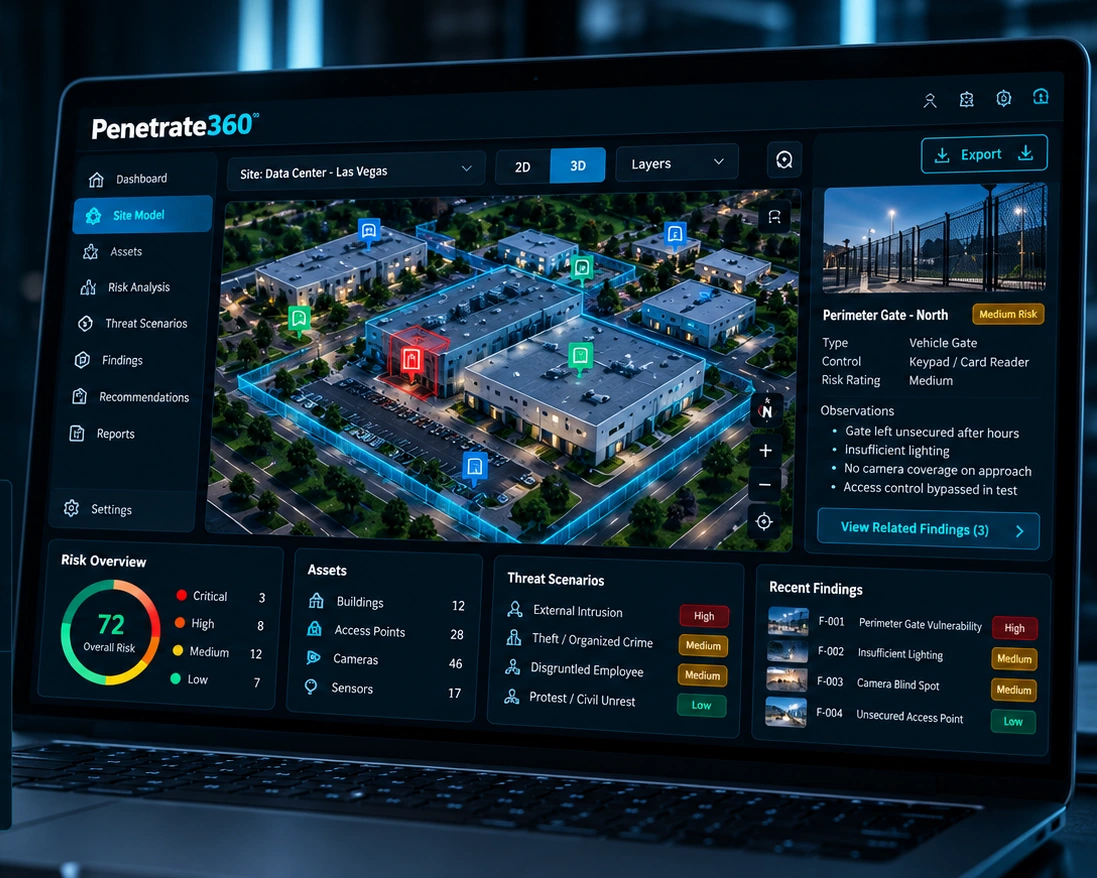
YOUR OUTCOME
An executive-friendly view of procedural and operational vulnerabilities, with prioritized actions for leadership, oversight, training and documented security processes.
COMMON QUESTIONS
Within the agreed scope, we can assess the design and execution of guarding procedures, post orders, training and supervision without representing ourselves as a staffing provider.
Where findings support it, we can recommend changes to coverage, role clarity, supervision or training, supported by observed risks and operational requirements.
Yes. A program assessment can provide context for authorized controlled testing and make findings more useful to leadership.
START WITH A CONVERSATION
Tell us about your security objectives. We’ll discuss an appropriate, confidential scope before any testing begins.