Doors, gates & restricted entry
Assess controlled entry points, hardware condition, door-prop practices, access paths and their role in the protective boundary.

PHYSICAL ACCESS CONTROL / INDEPENDENT ASSESSMENT
Know who can enter—and where your controls can fail.
An access control system is only as strong as the doors, credentials, rules and human decisions around it. We evaluate whether the safeguards protecting restricted spaces work together under realistic conditions.

THE OBJECTIVE
Phantom PenTest examines how authorized people, visitors and contractors move through a facility. We evaluate the physical entry points and operating procedures that determine whether access is truly controlled—not simply whether a reader or lock has been installed.
Our findings focus on the interaction among people, processes, facilities and physical security technology. They explain why observed gaps matter and how the organization can respond.
ASSESSMENT SCOPE
Every engagement is tailored to the facility, the threats that matter and the boundaries the client authorizes.
Assess controlled entry points, hardware condition, door-prop practices, access paths and their role in the protective boundary.
Review badge issuance, role-based access, visitor credentials, lost badge response, and the removal of access when no longer required.
Examine visitor processing, identity verification practices, escort expectations and contractor check-in and check-out procedures.
Evaluate how staff behavior, entry design, alerts and supervision affect unauthorized following and bypass opportunities.
Review access events, forced/held-door response procedures and escalation for unexpected or after-hours entry.
Consider security restrictions alongside emergency egress, accessibility and applicable life-safety requirements; avoid recommending unsafe locking practices.
WHY IT MATTERS
These examples illustrate common physical security challenges. They are not findings from an actual Phantom client assessment.
An access policy may be thorough while practical controls at deliveries, shift changes and visitor routes remain inconsistent.
Credentials and permissions can persist beyond a role or engagement unless issuance and revocation are governed.
A door alarm is less useful when monitoring, response instructions and responsibility are unclear.
THE PENETRATE360 ADVANTAGE
Penetrate360 is Phantom PenTest’s proprietary visual assessment platform. It helps turn complex facility conditions, security assets and threat scenarios into a clearer understanding of risk—so leadership can see where to focus improvements.
Discover Penetrate360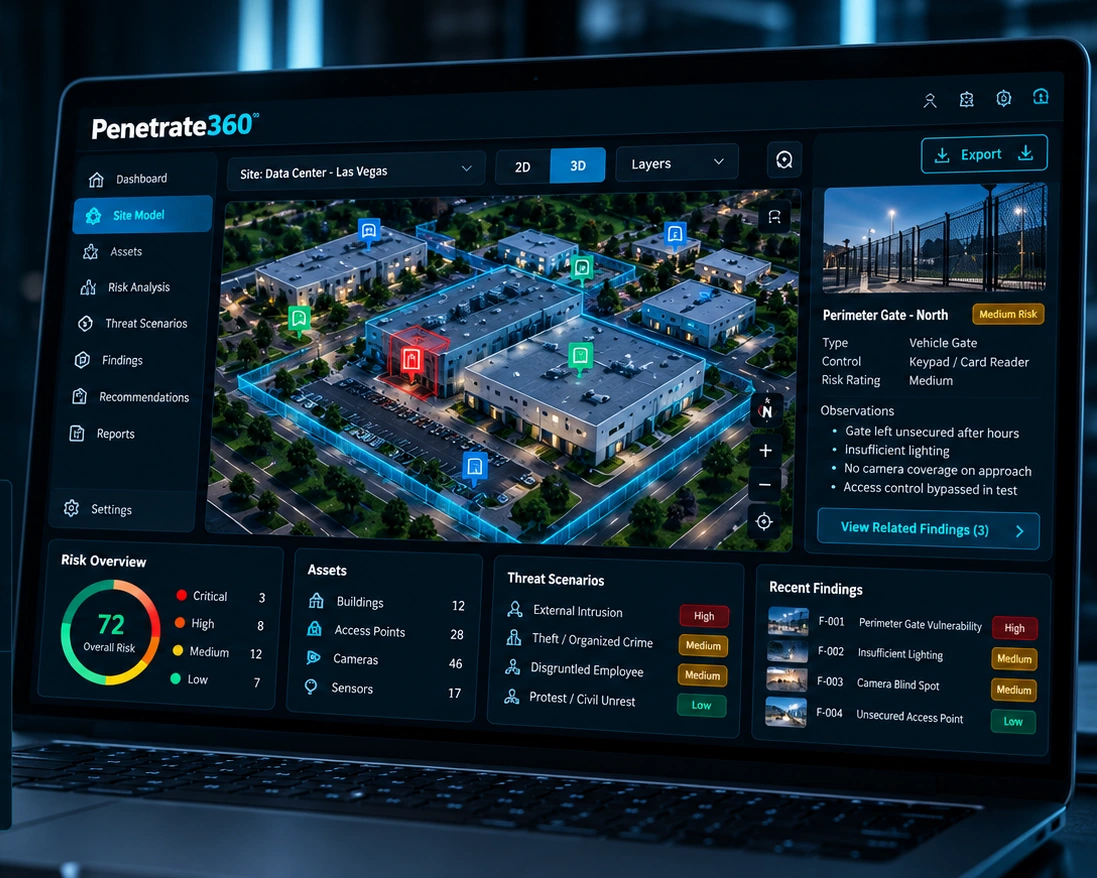
YOUR OUTCOME
A prioritized picture of where access can be gained or maintained outside approved rules, with evidence and practical recommendations for stronger door controls, credential governance and visitor procedures.
COMMON QUESTIONS
Controlled entry testing is performed only when specifically authorized in the written rules of engagement. An assessment may also be limited to observation, interviews and procedural reviews.
Yes. A physical access control assessment can focus on device placement, permissions, workflows and observed performance without altering configurations or conducting network testing.
Where it falls within scope, recommendations consider applicable life-safety and egress obligations. The assessment does not replace a code-compliance inspection by the authority having jurisdiction.
START WITH A CONVERSATION
Tell us about your security objectives. We’ll discuss an appropriate, confidential scope before any testing begins.